> For the complete documentation index, see [llms.txt](https://www.sunscan.net/llms.txt). Markdown versions of documentation pages are available by appending `.md` to page URLs; this page is available as [Markdown](https://www.sunscan.net/use/retrieve-your-data.md).

# Retrieve your data

Everything the SUNSCAN records is stored on the Raspberry Pi's microSD card. You pull it onto a computer with nothing more than a web browser, through the web interface built into the SUNSCAN.

{% hint style="info" %}
This portal is not only there to browse your data: it is also how you back it up. A microSD card does not last forever, and space on the SUNSCAN is limited.
{% endhint %}

{% hint style="warning" %}
Several items described here require firmware 2.1. The app offers the update as soon as it detects a SUNSCAN that needs it.
{% endhint %}

## Connecting to the web interface

The SUNSCAN must be powered on, and your computer must be on the same network. Two situations are possible.

* **The SUNSCAN is on your home Wi-Fi:** this is now the recommended route. From the app Settings, the SUNSCAN joins your Wi-Fi network; your computer is already on it. Nothing to switch, and you keep your internet connection while downloading.
* **The SUNSCAN is in hotspot mode:** this is the fallback, in the field or when there is no Wi-Fi. Connect your computer to the SUNSCAN's `sunscan-******` network, with the password `SunScanByStaros`.

Then open a browser and go to [**http://sunscan.local**](http://sunscan.local)

The address is the same either way.

{% hint style="info" %}
`.local` name resolution is unreliable on Windows and Android. If the page does not load, type the SUNSCAN's IP address instead: the mobile app shows it.
{% endhint %}

## A fully redesigned web interface

The old interface was deliberately minimalist. It has been rebuilt from the ground up, and now handles all of your data.

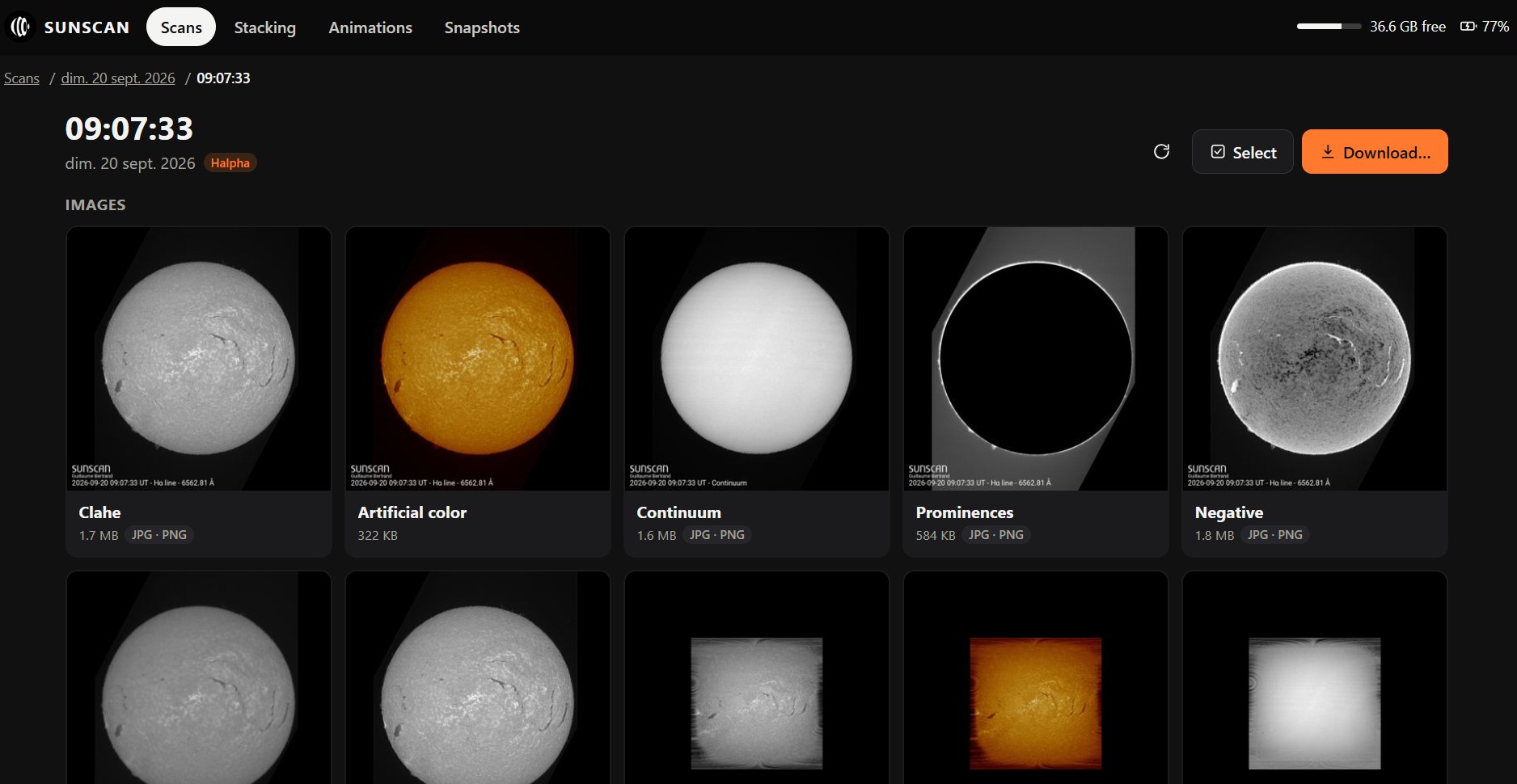
* **One navigation:** scans, stacks, animations and snapshots in a single place, with multiple selection, download and delete.
* **Full-screen viewer:** zoom, rotation and FITS preview, without downloading anything first.
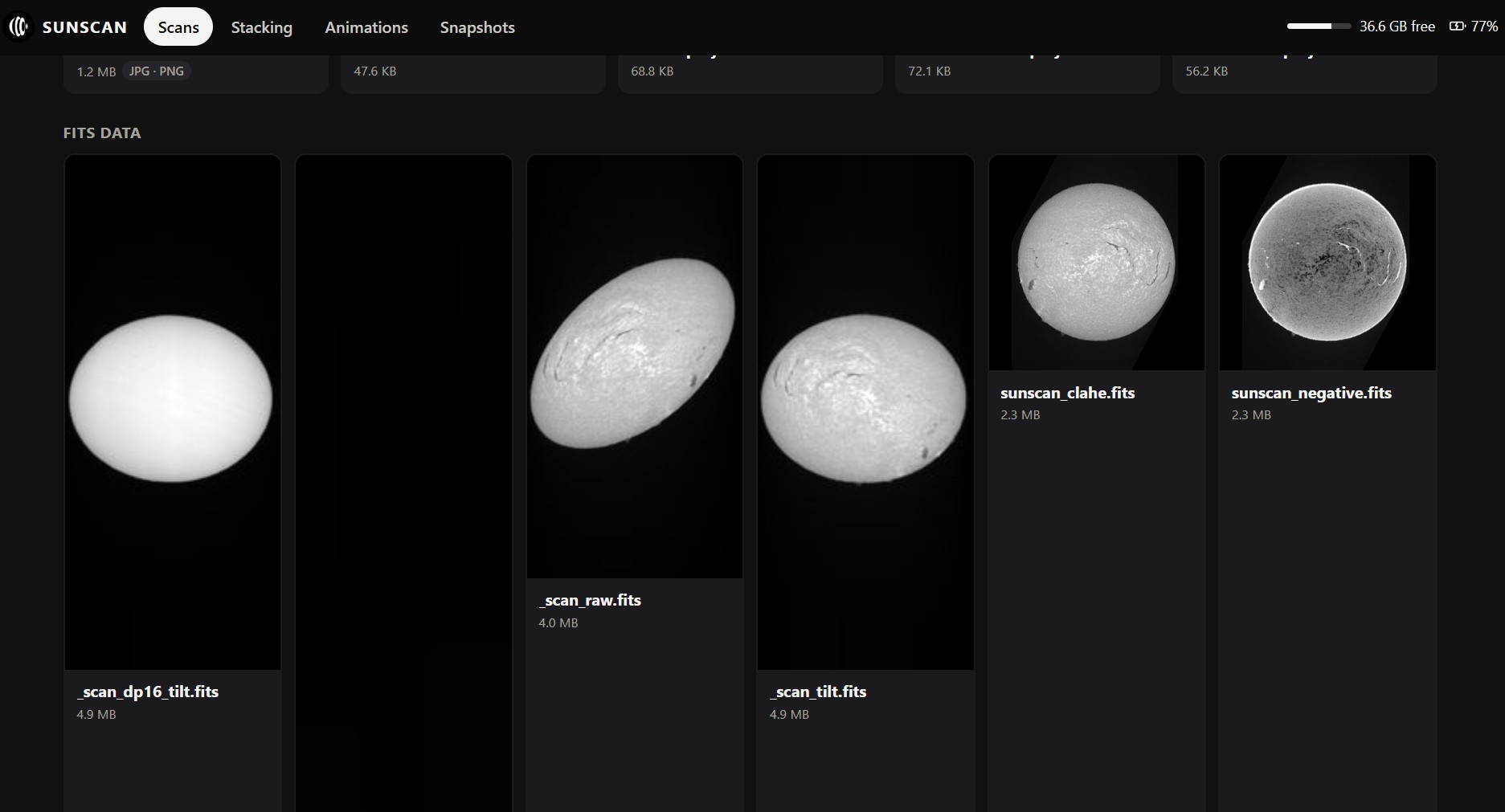
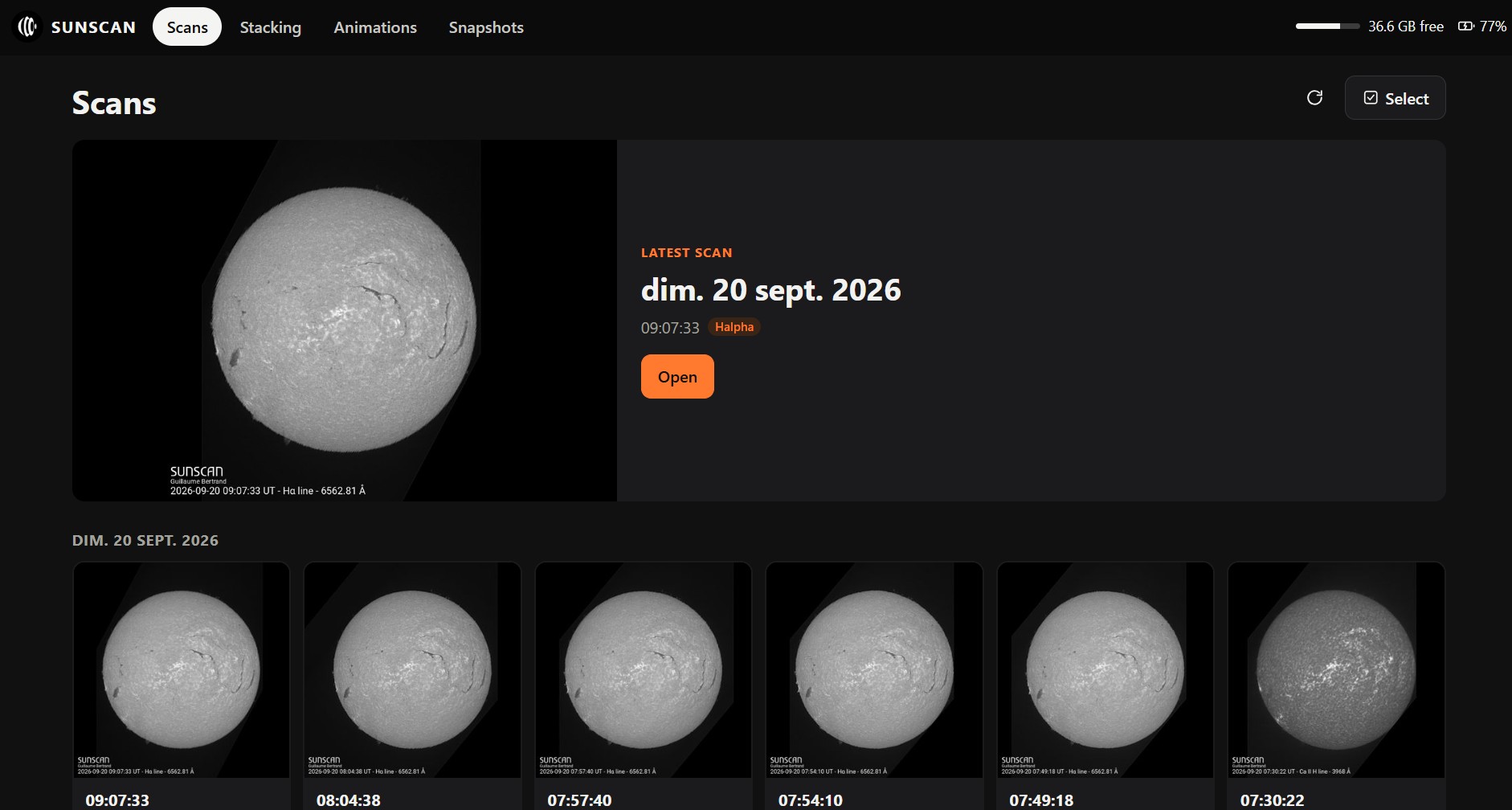
* **File type picker:** you tick the file types to download, and their size is shown up front.
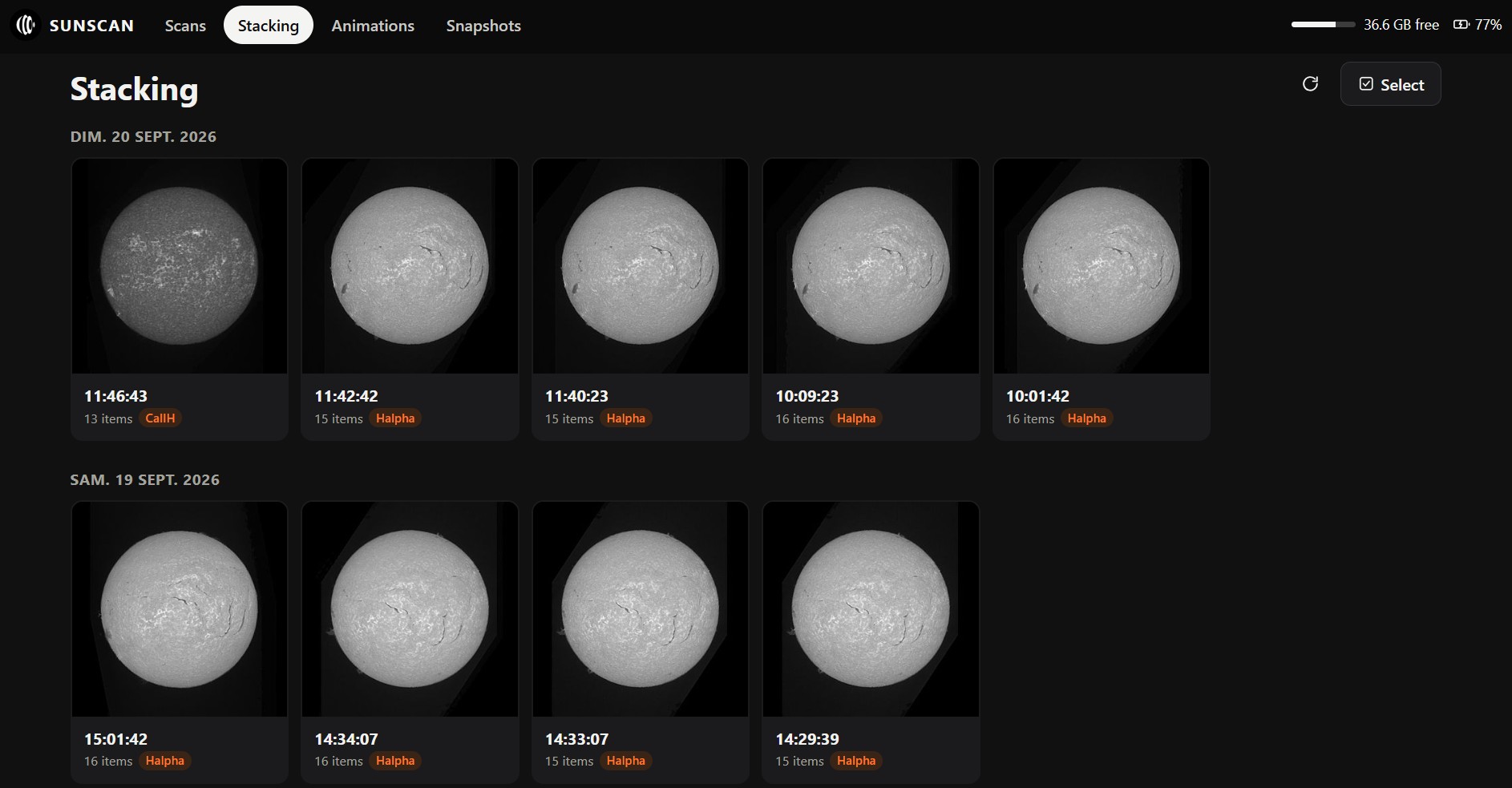
* **Indicators:** remaining storage space and the SUNSCAN's battery level are always visible.

<figure><img src="https://3365769115-files.gitbook.io/~/files/v0/b/gitbook-x-prod.appspot.com/o/spaces%2Fj8VBNLZ1OZic6lJdEMn0%2Fuploads%2FqeXu41MTgMhXazIgCmGa%2Fsunscan-2-1-web-home.jpg?alt=media" alt=""><figcaption><p>The web interface home: the latest scan, observations grouped by day, and the storage and battery indicators.</p></figcaption></figure>

<figure><img src="https://3365769115-files.gitbook.io/~/files/v0/b/gitbook-x-prod.appspot.com/o/spaces%2Fj8VBNLZ1OZic6lJdEMn0%2Fuploads%2FlzgXvurzUP6MlUxS8Zec%2Fsunscan-2-1-web-stacking.jpg?alt=media" alt=""><figcaption><p>A single navigation for scans, stacks, animations and snapshots.</p></figcaption></figure>

<div><figure><img src="https://3365769115-files.gitbook.io/~/files/v0/b/gitbook-x-prod.appspot.com/o/spaces%2Fj8VBNLZ1OZic6lJdEMn0%2Fuploads%2Fm23Tc5lUCPi7fziKCMGB%2Fsunscan-2-1-web-scan.jpg?alt=media" alt=""><figcaption><p>A scan's screen: each image shows its size and formats, and the Download button opens the file selection.</p></figcaption></figure> <figure><img src="https://3365769115-files.gitbook.io/~/files/v0/b/gitbook-x-prod.appspot.com/o/spaces%2Fj8VBNLZ1OZic6lJdEMn0%2Fuploads%2FdcC4OnXxrkp9LO1mRzAg%2Fsunscan-2-1-web-fits.jpg?alt=media" alt=""><figcaption><p>The FITS files of the same scan, with their size shown before downloading.</p></figcaption></figure></div>

## What you can download

* **Raw scan data:** a 16-bit PNG named `sunscan_raw.png`, for high-quality post-processing.
* **Processed images:** every image produced by the SUNSCAN, in JPG format.
* **Original raw video:** the SER file, the standard format for astronomical video capture.
* **Processing logs:** to track and review each processing step.

The SER file and the 16-bit PNG are the only files that let you reprocess a scan later: to add the spectral line to the watermark, for instance, or to get the Hε images of a Ca II H scan. Back those up first.

## What about SpectroSolHub?

{% hint style="warning" %}
**Uploading an observation to SpectroSolHub is not a backup.** Only the JPEG images you selected are sent to the hub. The SER file, the FITS files and the 16-bit PNG stay on the SUNSCAN: deleting an uploaded scan means losing its raw data, and it can never be reprocessed. Downloading from the web interface remains the only real backup.
{% endhint %}

Uploading and backing up answer two different needs: sharing on one side, keeping on the other. For uploading, see [Share your images](/use/share/integrations.md).